How Much Does AI Really Cost? Pricing Comparison 2026
Table of Contents
I added up every AI subscription on my card last month out of curiosity. $187. Not a single one of those tools felt expensive on its own — $20 here, $16 there, a $29 add-on I’d forgotten existed. The total only became real once I saw it as one number instead of six separate, individually reasonable charges.
That’s apparently a pattern, not just me being careless. Gartner’s research found that roughly 31% of AI tools small businesses pay for go completely unused within 90 days of signing up. Nobody budgets for an AI stack on purpose and ends up wasting a third of it — it happens through a series of small, individually defensible decisions that never get reviewed as a whole.
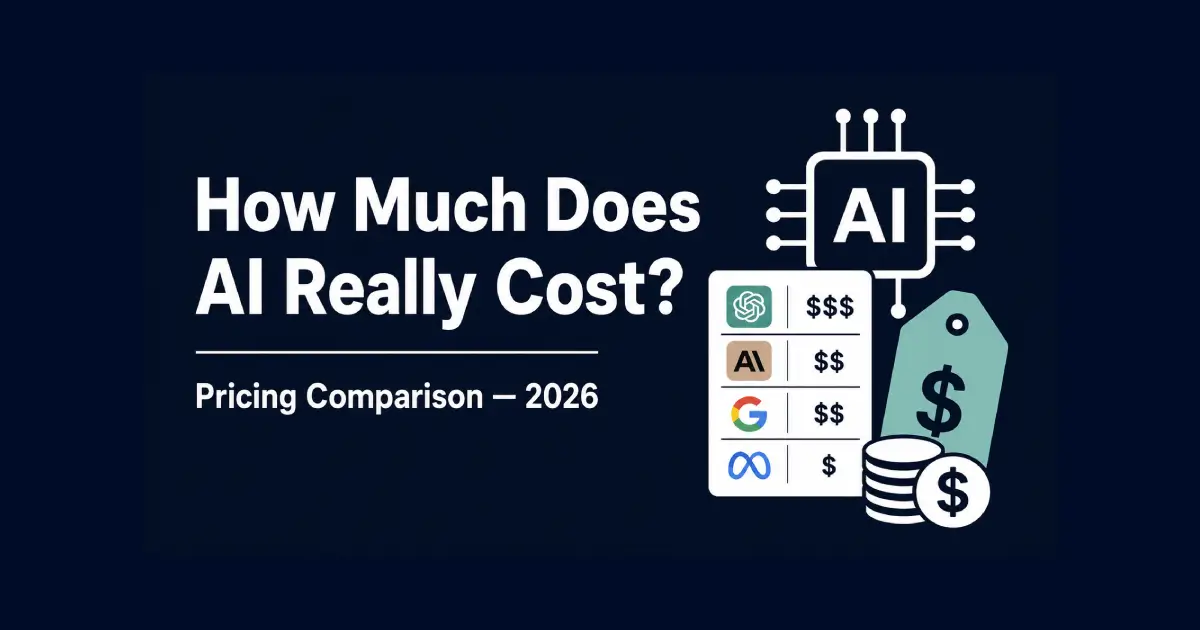
This is what AI actually costs in 2026, broken down by realistic spending tiers rather than a wall of individual tool prices, so you can see where your own stack sits and whether it matches what you’re actually using.
The Short Answer
A genuinely free AI stack — ChatGPT, Claude, and a couple of free-tier specialty tools — covers real work for individuals and very small operations. A $20-50/month stack is the most common starting point for solo operators and freelancers. A $65-300/month stack is what small business research consistently points to as the realistic range for a small team running AI across a few core functions. Above $300/month, you’re usually paying for either a growing team’s seat count or genuine specialization, not basic capability — the underlying AI usually isn’t smarter, just more available to more people or with higher usage caps.
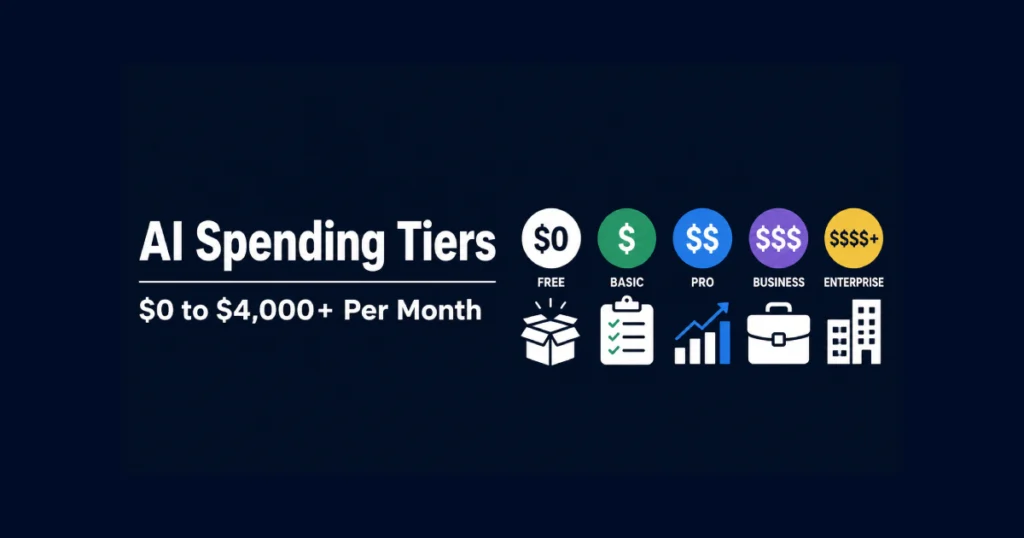
AI Tool Costs in 2026 — Full Breakdown by Spending Tier
The $0 Stack — Free Tiers, Real Work
Free doesn’t mean limited to toy use anymore. ChatGPT‘s free tier and Claude’s free tier both handle genuine daily writing, research, and reasoning tasks. Add a free-tier automation tool and a free-tier meeting assistant, and an individual or two-person operation can run on $0 for months before hitting a real limit worth paying to remove.
The catch isn’t capability — it’s reliability of access. Free tiers come with usage caps that reset on schedules you don’t control, and during busy weeks you’ll hit them at the worst possible moment. For occasional or moderate use, that’s a fair trade. For anything you depend on daily for client-facing work, the free tier becomes a quiet source of stress once you’ve built a workflow around a tool that might throttle you mid-task.
The $20-50 Stack — The Solo Operator’s Starting Point
This is where most individual professionals and freelancers land, and for good reason. ChatGPT Plus or Claude Pro at $20/month each covers the bulk of writing, research, and reasoning work most people need. Add a second specialized tool — an automation platform starting around $16/month, or a meeting assistant around $10-20/month — and you’re at $30-50/month total for a genuinely capable personal stack.
The research on this tier is consistent: the combined cost of Claude Pro and ChatGPT Plus, at roughly $40/month combined, is regularly compared against the $500 to $3,000 a month equivalent freelance or agency work would cost for comparable output. That's not a subtle ROI case — it's the main reason this tier has become the default starting point rather than a luxury.
The mistake at this tier isn’t overspending, it’s under-auditing. Most people add the second and third tool here and never revisit whether they’re actually using all three. The $40-50/month stack quietly becomes $70-80/month within a year as trial subscriptions convert to paid ones nobody remembers signing up for.
The $65-300 Stack — The Small Business Range
Multiple independent surveys converge on this exact range for small businesses running AI across a few core functions: an AI assistant around $20/month, an automation platform in the $16-50/month range, a customer-facing AI tool in the $29-169/month range depending on volume, and a meeting or scheduling tool at $0-20/month. Add them up and most small businesses land between $65 and $300 monthly, depending on team size and which functions they’ve actually automated.
The data on tool count matters as much as the dollar figure here. Businesses running three to five well-integrated tools report roughly double the productivity gains of businesses running ten or more fragmented apps. More tools in this range doesn’t mean more value — it usually means more subscriptions nobody has time to actually learn well. The median small business in 2026 uses about five AI tools total, and that number has proven to be a genuine sweet spot rather than an arbitrary stopping point.
Average annual AI subscription spend for small businesses sits around $2,340 to $2,400 — almost exactly $195-200/month, landing right in the middle of this tier. That figure tracks closely with what the research above predicts, which is a useful sanity check if your own stack looks wildly different in either direction.
The $300-1,000 Stack — Growing Teams and Per-Seat Costs
Past $300/month, the driver usually isn’t tool sophistication — it’s seat count. A 10-person team paying $20/user/month for one assistant alone is already at $200/month before adding anything else. Mid-size businesses (10-250 employees) average around $460/month on AI tools total, which usually reflects multiple seats on two or three core tools rather than dozens of specialized ones.
This is also where the gap between advertised usage and paid conversion starts mattering. Reporting on platforms like Microsoft Copilot has highlighted a real difference between how many employees have access to a tool and how many actually use it regularly — a company paying for 50 Copilot seats when 15 people use it daily is paying enterprise-tier prices for small-team-tier usage.
The $1,000+ Stack — Enterprise and Specialized Tooling
Enterprise companies average around $4,100/month on AI tools, and at this scale the conversation shifts from per-seat subscriptions to platform contracts, custom pricing, and governance requirements that smaller tools don’t offer at any price. This tier isn’t really comparable to the others — you’re not paying more for the same capability, you’re paying for compliance, support SLAs, and integration work that doesn’t exist as a line item for a $20/month consumer plan.
If you're reading this article trying to budget a small business or freelance stack, this tier is mostly irrelevant context rather than a target to aim for. The capability gap between a well-chosen $200/month stack and a $4,000/month enterprise contract is much smaller than the price difference suggests, for anyone outside the size and compliance requirements that justify enterprise tooling.
The Hidden Costs Nobody Puts on the Pricing Page
Every number above is the subscription price. None of it accounts for what actually eats budgets quietly over time. Three things consistently get missed:
Billing model changes happen more often than vendors advertise. GitHub Copilot restructured its entire billing model in mid-2026 without changing headline prices — the same dollar amount suddenly metered usage differently. If you budgeted based on last year’s limits, this year’s bill can surprise you even though the price tag looks identical.
Per-seat costs scale faster than people expect. A tool that looks like “$20/month” in a comparison article is actually $20/month per person once your team grows past one. A five-person team budgeting based on the single-user price they saw in a review is quietly underbudgeting by 5x before they’ve added a single extra feature.
Trial-to-paid conversion happens silently. Free trials that auto-convert to paid plans are the single most common source of the “31% unused” problem — not because anyone decided to keep paying for something useless, but because nobody actively decided anything at all. The subscription just continued.
How to Choose Your AI Spending Tier
Start with the 90-day unused-tool problem before adding anything new. Gartner’s 31% figure isn’t a reason to avoid paying for tools — it’s a reason to actually check, on a calendar reminder, whether you used each subscription in the last month. The tools that survive that check are worth their cost almost by definition. The ones that don’t are the $30-50/month leak sitting quietly inside an otherwise reasonable stack.
Budget in two separate categories, not one. Subscription cost is the number on your card statement. Total cost includes the time spent learning a tool, the workflow disruption while switching to it, and the maintenance of keeping an integration working when an API changes. Research on small business AI spending found the gap between sticker-price subscriptions (~$2,400/year) and true total cost including training time and integration maintenance (~$4,000-5,000/year for a small team) is real and consistently underestimated upfront.
Match your tier to your actual function count, not your ambition. If you’re using AI for one function — writing, say — a $20/month single tool is the right tier, and jumping to a $300/month stack “to be ready” for functions you haven’t started using yet is exactly how the unused-tool problem starts. Add tiers as specific, current bottlenecks appear, not in anticipation of future ones.
A Simple Way to Actually Calculate Your Own Number
Skip the comparison charts for a minute and do this instead. List every AI subscription currently on a card somewhere — yours, your team’s, the ones procurement set up that nobody remembers approving. Next to each one, write down the last time it was actually opened and used for something real, not just logged into out of habit.
Anything untouched in the last 30 days goes in a "cancel or justify" column. Anything used weekly stays. This takes about fifteen minutes and catches most of the silent subscription creep that turns a reasonable $50/month stack into an unreasonable $150/month one without anyone deciding that on purpose.
Do this audit quarterly, not once. Tools that earned their place in January can quietly stop being used by June once a workflow changes, a team member who championed a tool leaves, or a cheaper alternative launches. The number that matters isn’t what you decided to pay for originally — it’s what you’re still genuinely using right now.
For the full pricing breakdown within any single category — automation platforms, productivity tools, or coding assistants specifically — see our dedicated guides: best AI productivity tools, best Zapier alternatives, and ChatGPT Pro vs Claude Pro for the specific tier-naming confusion between those two platforms’ paid plans.
Frequently Asked Questions
How much does AI really cost for a small business in 2026?
Somewhere between $65 and $300 a month, once you stop counting individual tools and start adding the receipts up. I’ve seen the average land right around $195-200 a month across multiple surveys, which lines up almost exactly with what I’d expect after going through my own card statement.
What’s the cheapest way to start using AI for business?
Free. I mean that literally, not as a sales pitch for the paid tier later. ChatGPT and Claude’s free tiers handle real writing and research before you ever touch a limit worth paying to remove. Most people start paying the day a specific task keeps bumping into that cap, not before.
Why do so many AI tool subscriptions go unused?
Because nobody goes back and checks. Gartner found about 31% of small business AI subscriptions sit completely unused within 90 days — not because the tools were bad, just because the initial “this will help” excitement faded and nobody cancelled or revisited it. I’d guess that number is generous, honestly.
Is it worth paying for both ChatGPT and Claude?
For anyone doing real client or business work, yeah, I’d say so. $40 combined sounds like a lot until you put it next to $500-3,000 a month for equivalent freelance or agency output. They’re genuinely different tools that happen to overlap on the surface — running both isn’t the redundancy it looks like on a spreadsheet.
How many AI tools should a small business actually use?
Around five, give or take, based on what the survey data keeps showing. I’ve watched teams with ten-plus scattered tools get half the productivity gain of teams running three to five that actually talk to each other. More subscriptions rarely means more value past that point — usually the opposite.
What’s the real difference between a $20/month tool and a $200/month one?
Usually it’s how much you get to use it, not how smart it is. A $200 tier typically buys more requests or seats, not a fundamentally better brain behind the screen. Before assuming the expensive plan does more per task, check what number actually changes — request limits, seats, storage — because half the time it’s just volume.
How do I know if I’m overpaying for my current AI stack?
Look at what you actually opened in the last 30 days against what’s hitting your card. Anything untouched in that window is a candidate to cancel, full stop, no matter how reasonable the price felt when you signed up. I’d also be careful with annual billing — that 10-20% discount stops looking smart the moment you remember a third of these subscriptions get abandoned within 90 days anyway.
At what point does an AI stack become enterprise-level spending?
Somewhere past $1,000 a month, you’re not really paying for smarter AI anymore — you’re paying for compliance, dedicated support, and contracts that don’t exist at the consumer tier. Enterprise companies average around $4,100 a month, but that number reflects governance requirements most small businesses reading this article simply don’t have.