Best AI Tools for Ecommerce in 2026 — Tested on Real Online Stores
Table of Contents
A store with three hundred products and no one to write three hundred unique descriptions. A cart abandonment rate nobody’s tracking closely enough to fix. A pricing sheet that hasn’t been touched since launch while competitors quietly undercut it every week. These are the problems that actually slow down a growing ecommerce platform, and they’re rarely the ones founders mention first.
The most useful ai tools for ecommerce businesses in 2026 split across a handful of real jobs: writing product copy at scale, recovering revenue through smarter email and SMS, personalizing what shoppers see, pricing competitively without a full-time analyst, and helping shoppers find what they’re looking for. None of this replaces a customer support tool — we cover that ground separately in our guide to AI customer service platforms. This is about the store itself: the catalog, the pricing, and the path from browsing to checkout.
The Short Answer
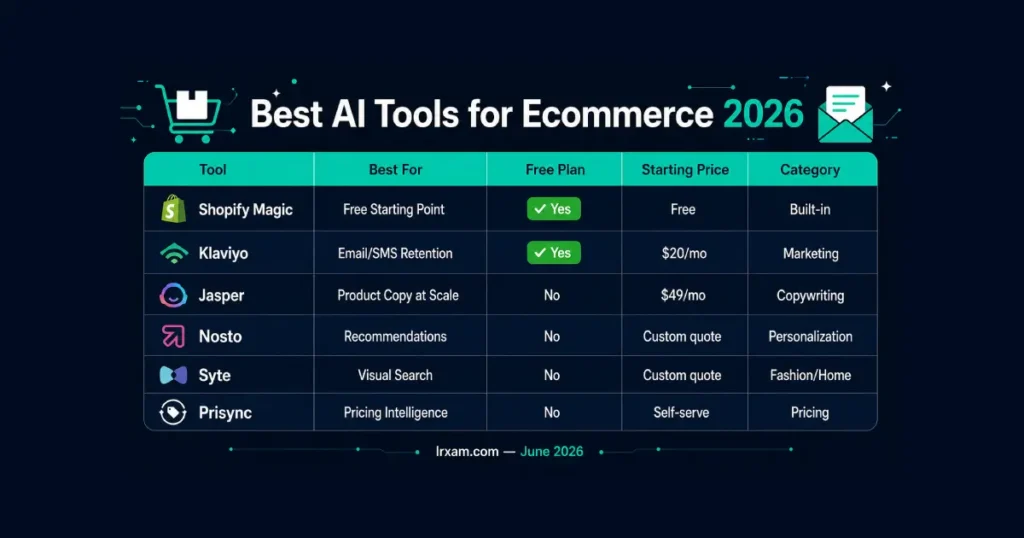
Shopify Magic is the best free starting point for any Shopify store. Klaviyo leads on email and SMS retention with genuinely predictive automation. Jasper is the strongest choice for brand-consistent product copy across a large catalog. Nosto handles personalized product recommendations well without an enterprise budget. Syte is built specifically for visual search in fashion and home goods. Prisync covers competitive pricing intelligence for smaller teams that can’t justify an enterprise repricing platform.
Where AI Actually Moves Ecommerce Revenue
Every platform in this space claims a “personalization engine” or “AI-powered discovery” story, and a lot of that is rule-based logic wearing a machine-learning label. This is already a fairly mature ai category in ecommerce, which means the gap between marketing claims and what tools across this list actually deliver is easier to spot than it was a couple of years ago.
Product copy, email automation, and pricing intelligence are where AI most reliably replaces hours of manual work with output that’s genuinely as good or better. Personalization and visual search are real categories too, but the quality gap between vendors is wider — a poorly trained recommendation engine can hurt conversion rate just as easily as a good one helps it. Among AI tools in this space, the benefits of using AI show up fastest in the categories with the most historical data to learn from.
What doesn’t change: strategy, brand judgment, and the relationships that turn a one-time buyer into a repeat customer still need a person. The tools below help with execution. They don’t replace deciding what the store should actually be.
That distinction matters most with pricing and personalization, where the line between “AI-assisted decision” and “fully automated decision” gets blurry fastest. A repricing tool that automatically matches every competitor’s lowest price will protect market share while quietly destroying margin if nobody’s watching the rules it’s running. The best tools here are the ones a person still configures and checks regularly, not the ones treated as a set-and-forget dashboard.
Best AI Tools for Ecommerce in 2026 — Full Breakdown
1. Shopify Magic — The Free Starting Point Built Into the Admin
If a store runs on Shopify, Shopify Magic is the first tool worth turning on, mostly because there’s no reason not to. It’s included in the admin panel — no separate login, no data export between systems, no extra monthly fee on top of the existing Shopify plan.
The product description generator takes a few keywords and a product type and produces usable starting copy, which matters most for stores with large catalogs where writing hundreds of unique descriptions by hand simply doesn’t happen. The image background removal and replacement tools handle a task that used to require either design skill or an outsourced editor.
It won’t match a dedicated copywriting tool on nuance, and the personalization features are basic compared to a specialized platform. For a store just getting started, or for the routine 80% of catalog work that doesn’t need a creative push, it’s hard to justify paying for something else first.
2. Klaviyo — Best for Email and SMS Revenue Recovery
Klaviyo has become the default email and SMS platform for ecommerce, and the AI layer underneath it is a genuine revenue driver rather than a scheduling convenience. It predicts next purchase dates, flags churn risk before a customer fully disappears, and powers automated flows — abandoned cart, welcome series, post-purchase, win-back — using actual purchase and browsing history rather than generic timing rules.
The send-time optimization is the feature that surprises people most. Rather than blasting every subscriber at the same hour, it learns when each individual is most likely to open and adjusts delivery per contact. Reported open rate improvements in the 24% to 31% range aren’t unusual once this is running across a full list, based on case studies Klaviyo and its agency partners have published.
Segments built from plain-language descriptions are the other genuine time-saver — describing the audience you want rather than building filter logic manually. For a store with two hundred or more SKUs, the AI-driven product recommendation blocks inside emails also meaningfully outperform static product callouts. The platform’s ecommerce analytics layer uses ai to track performance per flow, which makes it easier to see which automation tools inside the platform are actually earning their keep.
Free up to 250 contacts. Paid plans start around $20/month and scale with list size from there.
3. Jasper — Best for Brand-Consistent Copy at Catalog Scale
Jasper is an ai writing engine that has shifted its positioning toward ecommerce marketing specifically, and the brand-governance angle we covered in our broader content creation guide applies with extra weight here. Upload a style guide, past high-performing copy, and product specifications, and this powerful ai generates descriptions, ad copy, and email content that stay consistent across a catalog too large for one person to write by hand.
The Campaign feature is the most genuinely useful addition for ecommerce specifically: feed it one product URL and it generates a blog post, a set of ad variations, and an email sequence that read like the same person wrote all three — instead of three disconnected pieces from three separate prompts. A newer Performance Prediction layer scores draft copy against current search trends and competitor positioning before it ever gets published, which is a meaningfully different workflow than writing blind and checking analytics two weeks later.
It costs more than Shopify Magic, and for a small catalog the gap in output quality may not justify the price difference. For a catalog large enough that brand voice drift becomes a real risk across dozens of writers or templates, it earns its place.
Creator plans start at $49/month, scaling with team size and usage from there.
4. Nosto — Personalized Recommendations Without an Enterprise Contract
Nosto sits in a useful middle ground: real personalization and product recommendation capability without the enterprise sales cycle and budget that platforms like Bloomreach or Dynamic Yield typically require.
It builds recommendation logic from actual browsing and purchase behavior — “customers who viewed this also bought” done with genuine modeling rather than a simple co-purchase rule — and extends that personalization into onsite pop-ups, category pages, and email content blocks. For a mid-size store that has outgrown Shopify’s native recommendation logic but isn’t ready for a six-figure enterprise platform, this is the realistic next step.
The depth doesn’t match the largest enterprise platforms, and stores with genuinely massive catalogs spanning tens of thousands of SKUs may eventually need that extra horsepower. For most growing stores, the gap between Nosto and the enterprise tier is smaller than the price difference suggests.
5. Syte — Visual Search Built for Fashion and Home
Syte solves a specific problem text-based search handles poorly: a shopper finds a product they like in a photo — on social media, in a magazine, on someone else’s site — and wants to find something similar in your catalog without knowing what to type.
The retail-specific training is what separates it from a general-purpose image search bolted onto a storefront. It understands fashion and home-goods attributes specifically — silhouette, pattern, material, room style — in a way that generic visual search APIs trained on broader image sets don’t match. For categories where shoppers browse visually before they ever type a search term, that specificity shows up directly in conversion data.
Outside fashion, beauty, and home goods, the advantage narrows considerably. A hardware store or a B2B parts catalog gets far less value from visual similarity matching than from accurate, fast text and attribute-based search instead.
6. Prisync — Competitive Pricing Intelligence for Smaller Teams
Prisync tracks competitor pricing automatically and applies rule-based repricing without requiring the procurement process and budget that enterprise pricing platforms usually demand.
For a store that’s been setting prices once at launch and rarely revisiting them, this closes a gap that quietly costs revenue every week competitors move and a store doesn’t notice. The setup is genuinely self-serve — no sales call required to see current pricing or start a trial, which is unusual in this specific category where most vendors hide pricing behind a “contact us” form.
It’s rule-based repricing rather than the more advanced predictive pricing models enterprise platforms run, so it won’t catch every nuance a dedicated pricing analyst would. For a small or mid-size team without that analyst on staff, automated competitive tracking alone is a meaningful improvement over not tracking it at all — most stores at this size are pricing reactively off gut feel rather than current market data.
A Few More Worth Knowing
Product photography is the gap most “best ai tools for ecommerce” lists skip entirely. Midjourney is an ai image generator increasingly used by ecommerce brands selling products that are expensive or impractical to photograph in every setting — generating lifestyle backgrounds, seasonal variations, and creative concept shots from a single product photo rather than booking a studio session for each one. We cover the wide range of ecommerce-relevant options in our guide to free AI image generators, several of which work well for this exact use case.
For ecommerce customer support specifically — order status, returns, shipping questions answered with real store data — Gorgias remains the strongest purpose-built option. Tidio’s Lyro AI agent handles lighter conversational AI needs for smaller stores that don’t need a full helpdesk yet. Both get the depth they deserve in our guide to AI customer service tools rather than repeated here.
For content that needs to rank in search rather than just convert once a shopper lands on the page, our AI tools for SEO guide covers the keyword and optimization layer that pairs with any of the copywriting tools above.
How to Choose the Right AI Tools for Your Store
With many tools competing for the same budget, the goal isn’t to use every option — it’s choosing the right ai tools for the specific bottleneck slowing the store down right now. Catalog size is the first real signal. Under fifty products, Shopify Magic plus basic Klaviyo automation covers most of what matters, and a dedicated personalization or visual search platform is solving a problem the store doesn’t have yet. Past a few hundred SKUs, the manual cost of writing copy and tracking competitor pricing by hand starts justifying a dedicated tool in each category.
Category matters as much as size. A fashion or home goods store should weight visual search and personalization heavily, since shoppers in those categories browse before they search. A commodity or B2B-leaning store gets more value from pricing intelligence and accurate text search than from a recommendation engine trying to guess visual preference that barely exists in that category.
Tools help most when they’re chosen for a documented gap, not added speculatively because a competitor mentioned one. Using the right tools for growth means starting with whichever single bottleneck is costing the most revenue right now — written copy, abandoned carts, stale pricing, or poor product discovery — and solving that one well before evaluating the next category.
Budget reality matters too. Enterprise personalization and pricing platforms exist for a reason, but most growing stores are better served starting with the mid-market tools on this list and upgrading only once a specific tool’s ceiling becomes the actual bottleneck — not before. Adding five platforms before any of them is fully used rarely outperforms using two or three well.
One sequencing mistake shows up repeatedly: stores adopt a personalization or visual search platform before fixing the product copy and imagery those systems are supposed to surface. A recommendation engine built on thin, inconsistent product data recommends thin, inconsistent products more efficiently — it doesn’t fix the underlying catalog problem. Getting product descriptions, attributes, and images solid first, even with a basic tool like Shopify Magic, makes every tool layered on top of that foundation perform meaningfully better than the same tool bolted onto a messy catalog.
Frequently Asked Questions
What are the best AI tools for ecommerce in 2026?
Shopify Magic is the best free starting point for Shopify stores. Klaviyo leads on AI-driven email and SMS revenue recovery. Jasper handles brand-consistent product copy at catalog scale. Nosto covers personalized recommendations without an enterprise budget. Syte is the strongest visual search option for fashion and home goods. Prisync provides accessible competitive pricing intelligence. The right combination depends on catalog size, category, and which part of the funnel needs the most help.
Can AI actually write good product descriptions?
Yes for structured, factual copy like specs and materials; brand voice descriptions need a human editing pass. Tools like Shopify Magic or Jasper save real time across a large catalog. For copy meant to carry genuine brand personality or a distinctive voice, AI-generated drafts need a human editing pass before publishing. The most effective workflow uses AI for the first draft and structure, then adds the specific details and tone that make a listing sound like the brand rather than a template.
Does Google penalize AI-generated product descriptions?
No, not for being AI-generated specifically. Google’s guidance is consistent across content types: it penalizes content that’s low-value, repetitive, or unhelpful, regardless of how it was produced. A unique, accurate, well-structured AI-assisted description outranks a thin or duplicated human-written one. The risk isn’t the AI — it’s publishing generic copy without adding the specific details that make a listing genuinely useful.
How much do AI tools for ecommerce typically cost?
Shopify Magic is included free with a Shopify subscription. Klaviyo is free up to 250 contacts, then scales from around $20/month with list size. Jasper starts at $49/month for creator plans. Nosto, Syte, and Prisync generally require a quote based on catalog size and traffic, though Prisync is more transparently self-serve than most pricing-intelligence competitors. A small store can realistically start at $0-50/month and scale spending as specific tools prove their value.
Is personalization worth it for a small ecommerce store?
Not usually for small stores — personalization needs significant traffic and catalog data to outperform built-in logic. A store with under fifty products and modest traffic often gets more value from Shopify’s native recommendation logic than from a dedicated personalization platform, since there isn’t enough behavioral data yet to train a more sophisticated model well. Past a few hundred SKUs and meaningful daily traffic, a tool like Nosto typically starts outperforming the built-in logic.
What’s the difference between Klaviyo and a general email marketing tool?
General email tools send campaigns. Klaviyo is built specifically around ecommerce data — purchase history, browsing behavior, product catalog — and uses that data to power predictive automation: next purchase timing, churn risk, personalized product recommendations inside emails. For a store with real transaction history to learn from, that ecommerce-specific data layer is the actual differentiator, not the email editor itself.
Should I use visual search if I don’t sell fashion or home goods?
Probably not as a priority. Visual search tools like Syte are trained and tuned specifically for categories where shoppers browse by appearance — pattern, silhouette, material, style. Outside those categories, the same budget typically produces a better return spent on accurate text and attribute-based search, or on the pricing and email tools covered above.
Are there good free AI tools for ecommerce?
Yes — Shopify Magic is free for any Shopify merchant, and Klaviyo’s free tier covers stores under 250 contacts. For ecommerce brands that want to test AI image generation before committing to a paid plan, several of the free ai tools for ecommerce covered in our image generator guide work well for early-stage product photography needs. Most stores can build a real top ai tools for ecommerce stack starting at $0/month and add paid tools only once a specific free tier’s limit becomes the actual bottleneck.
What should an ecommerce store fix before adding AI tools?
Product data quality, almost always. Inconsistent or incomplete product attributes, thin descriptions, and inconsistent imagery undermine every AI tool layered on top of them — a recommendation engine or visual search system can only work with what’s actually in the catalog. Spending a week cleaning up product data before adopting a personalization platform typically produces a bigger improvement than the platform itself does on a messy catalog.