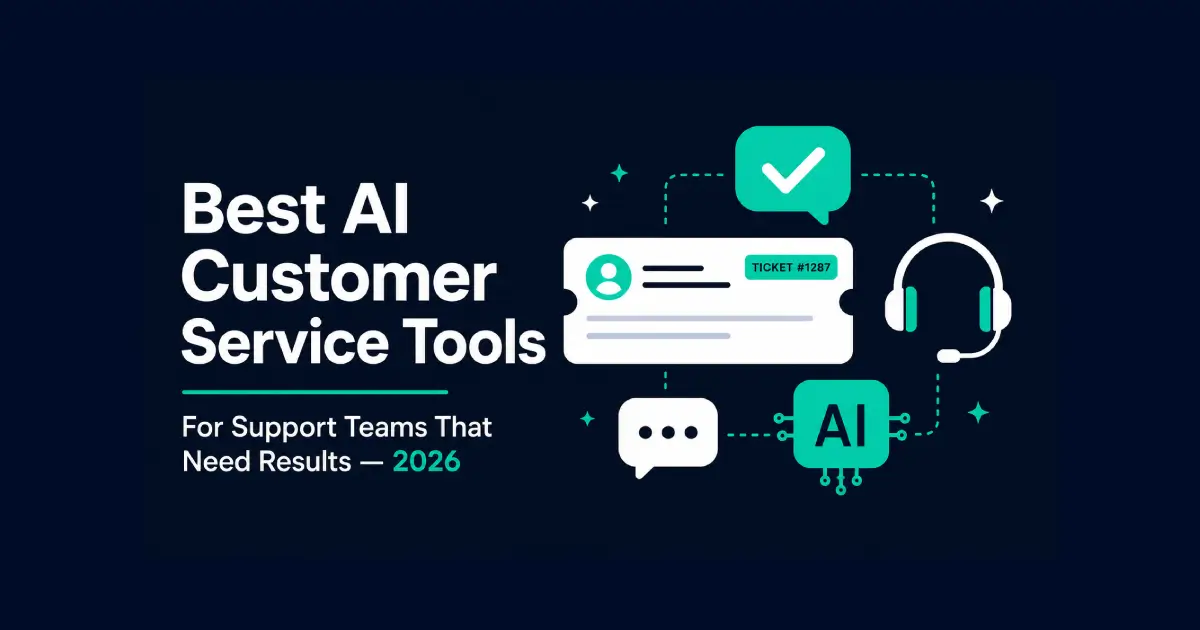
Best AI Customer Service Tools in 2026 — For Support Teams That Need Results
Table of Contents
A support team I talked to last month was drowning in the same twelve questions, asked a hundred different ways, every single day. Order status. Return policy. “Where’s my refund.” None of it needed a human, and all of it was eating the hours that should have gone to the customers with actual problems.
The right ai tool changes that math. Not by replacing a customer support team, but by automating customer interactions to clear the repetitive noise so the team can focus on what’s left. Some tools genuinely do this. Others are a chat widget with a marketing page calling it AI, yet they often fail to meet customer expectations. The difference shows up fast once real ticket volume hits them.
The Short Answer
Zendesk’s built-in AI agent is the strongest choice for large teams already running deep, complex workflows. Intercom Fin leads on raw resolution rate for SaaS and digital products, effectively addressing customer issues. Freshdesk with Freddy AI offers the most complete out-of-the-box automation for mid-market teams. Gorgias is built specifically for Shopify and ecommerce support. Help Scout suits small teams running support mostly over email while enhancing customer experience through effective communication. eesel AI is the best option for layering AI onto a helpdesk you already use without switching platforms. Re:amaze is the most affordable multichannel option for a small team.
What “AI Customer Service” Actually Means Now
The category splits into two genuinely different jobs, and most comparison articles blur them together.
Some platforms resolve customer interactions autonomously — a customer asks a question, conversational AI answers it correctly, and a human agent never sees the conversation. Other tools assist the human agent instead: drafting a reply, summarizing a long thread, pulling up the right knowledge base article before the agent even searches for it. Both count as ai-powered customer support, just at different points in the workflow.
Autonomous resolution is what gets the headline numbers. Intercom and Gorgias both publish figures around resolving 59-60% of incoming customer queries without a person involved. Agent-assist software rarely publishes a single flashy number, because its value shows up as reduced handle time and better customer satisfaction across thousands of conversations rather than one dramatic statistic.
Most teams end up needing both customer service AI tools and traditional support methods. The tools below cover that range, organized from full customer service platforms with AI built in, to lighter support tools that sit on top of a helpdesk you already run.
Best AI Customer Service Tools in 2026 — Full Breakdown
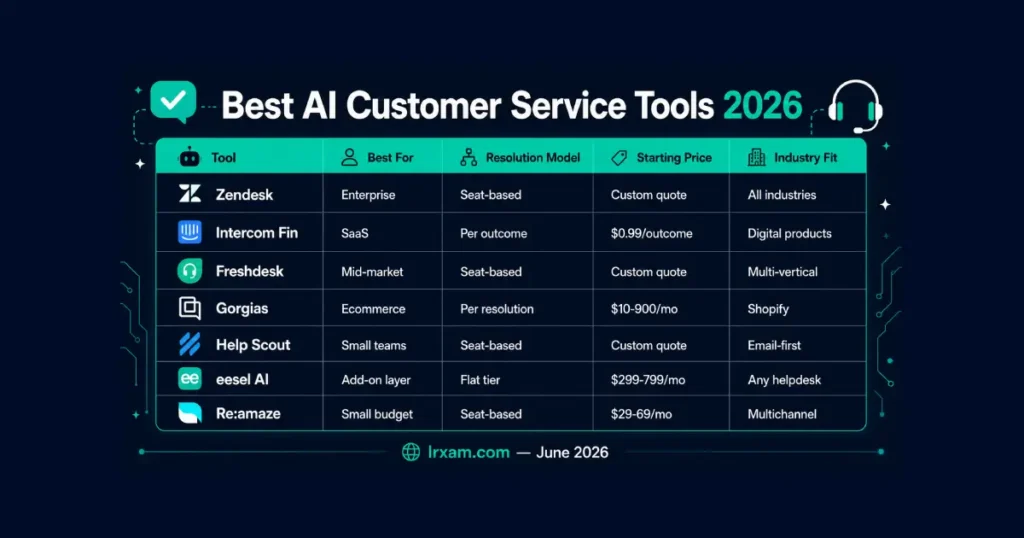
1. Zendesk — The Deep Enterprise Standard
Zendesk earned its reputation before AI was part of the conversation, and the AI layer it’s built since holds up to that reputation rather than feeling bolted on. The AI agent handles ticket triage, suggests replies based on the team’s own past resolutions, and routes conversations based on intent rather than simple keyword matching.
What sets it apart isn’t any single feature — it’s depth. Workflow automation, reporting, and the AI layer were clearly built to work together rather than acquired and stitched on afterward. For a support operation with complex routing rules, multiple departments, and high ticket volume, that integration matters more to overall customer experience than any one AI capability in isolation. It functions as a genuine ai platform rather than a chatbot with extra steps.
The tradeoff is complexity and cost. Smaller teams often find Zendesk has more configuration than they need, and the learning curve for admins is real. Pricing scales with seats and ticket volume rather than a single flat number, and it’s worth getting a current quote directly rather than relying on a published list price that changes by plan.
2. Intercom Fin — Best Resolution Rate for SaaS Support
Intercom‘s Fin AI agent is built around a single goal: resolve the conversation completely, not just respond to it. Intercom reports Fin automating up to 59% of incoming queries across email, chat, SMS, and social channels, including some that aren’t simple FAQ lookups.
What makes Fin specifically strong for SaaS and digital products is how it handles multi-step troubleshooting — walking a user through a setup problem rather than just pointing to a help article and hoping. The Copilot layer on top assists human agents with response drafts and conversation summaries when a ticket does need a person, pulling from customer data already stored in the helpdesk to keep replies relevant to that specific account’s history.
- The pricing model is unusual and worth understanding before committing. Fin runs on a per-outcome basis — $0.99 per resolved outcome with a 50-outcome monthly minimum, or $0.99 per outcome plus $29 per seat if you’re running Intercom’s own helpdesk underneath it. That structure rewards a tool that actually resolves things and penalizes one that doesn’t, which is a more honest pricing model than a flat seat fee regardless of performance.
3. Freshdesk with Freddy AI — Best Pre-Built Industry Automation
Freshdesk‘s automation engine stands out for a specific reason most competitors don’t match: a library of pre-built, vertical-specific agents covering ecommerce, fintech, HR, IT services, logistics, and travel, each already trained on the common issues in that domain — genuine customer service automation rather than a generic chatbot wearing different branding per industry.
For a mid-market team that doesn’t have the engineering resources to train a generic AI agent from scratch, starting from a vertical template that already understands “where’s my order” for ecommerce or “reset my password” for IT support shaves weeks off deployment. Freddy also handles voice through marketplace integrations, automating routine calls rather than only chat and email.
It’s not as deep as Zendesk for highly customized enterprise workflows, and the AI quality outside the pre-built verticals is more average. For the mid-market team it’s built for, the speed to a working setup is the genuine advantage.
4. Gorgias — Built Specifically for Shopify and Ecommerce
Gorgias doesn’t try to be a general-purpose helpdesk, and that focus is exactly why ecommerce stores keep choosing it. The AI Agent resolves the questions that dominate ecommerce support — order status, shipping delays, return requests — using actual store and order data pulled directly from Shopify, in the brand’s own voice rather than a generic tone.
The order data integration is what separates this customer support platform from a general AI chatbot bolted onto a store. The AI agent can see exactly where a specific order is and answer accordingly, instead of giving a customer a generic “track your order here” link and hoping that’s enough. It’s purpose-built ai software for one industry rather than a horizontal tool stretched to fit it.
Pricing scales by ticket volume rather than seats: a Starter tier around $10/month, Basic near $60, Pro around $360, and Advanced near $900 for high-volume stores. The AI Agent itself is billed per resolution, roughly $0.90 to $1.00 each — similar in structure to Intercom’s outcome-based model.
5. Help Scout — Lightweight AI for Small Support Teams
Help Scout takes a deliberately smaller approach than the enterprise platforms above. It’s built for teams running support mostly over email and shared inboxes, without the workflow complexity that comes with a full helpdesk suite.
The AI here assists rather than fully automates — drafting suggested replies, summarizing long customer conversations, and helping new hires get oriented faster by surfacing relevant past history. These support tools won’t resolve 60% of tickets autonomously the way Intercom or Gorgias claim to, and they aren’t trying to.
For a five-to-fifteen-person support team that finds Zendesk or Freshdesk’s depth unnecessary, Help Scout’s simpler scope is the actual selling point rather than a limitation.
6. eesel AI — The Layer You Add Without Switching Platforms
eesel AI solves a specific problem: a team happy with Zendesk or Freshdesk that wants real AI capability without migrating to a different helpdesk entirely. It connects to the platform already in use rather than replacing it.
It trains on existing documentation, past resolved tickets, and Slack conversations, then operates as a copilot inside the current helpdesk — drafting replies, suggesting actions, and eventually handling routine triage once it’s been trained on enough real history. This kind of ai-powered customer support keeps customer engagement consistent even as ticket volume grows. Bulk simulation lets a team test how it would have handled past tickets before trusting it with live ones, which is a more honest rollout than flipping a switch and hoping to automate customer support effectively.
Pricing is transparent and public: the Team plan runs $299/month ($239/month billed annually) for up to 1,000 AI interactions, and Business runs $799/month ($639/month annually) for up to 3,000 interactions, with custom enterprise pricing above that.
7. Re:amaze — The Affordable Multichannel Option
Re:amaze bundles email, live chat, social messaging, and SMS into one inbox with AI replies and chatbots layered on top, at pricing a small team can actually absorb without a budget conversation.
The AI depth doesn’t match Intercom or Zendesk, and that’s the honest tradeoff for the price. What it does well is cover a lot of channels from one place without forcing a team into enterprise-tier spending before they’re ready for it.
Basic runs $29/month per team member, Pro is $49, and Plus is $69 — with the stronger AI capabilities concentrated in the higher tiers rather than evenly spread across all three.
A Few More Worth Knowing
If the team is small enough that a full helpdesk feels premature, Tidio — which we cover in detail in our guide to free AI chatbots for websites — handles basic customer questions through a website widget without the overhead of any tool on this list. It’s the right starting point before a dedicated customer service platform becomes necessary at all.
For support workflows that lean heavily on internal documentation and meeting notes alongside customer-facing tools, our AI productivity tools enhance customer service and improve team efficiency. guide covers the adjacent tools — like automated meeting summaries — that often sit next to a support stack rather than inside it.
How to Choose the Right AI Customer Service Tool
Start with ticket volume and channel mix, not the feature list. A team handling under 500 tickets a month rarely needs Zendesk’s depth — Help Scout or Re:amaze covers that volume without the configuration overhead. Past a few thousand tickets monthly with multiple departments, the routing and reporting depth in Zendesk or Freshdesk starts paying for itself by enhancing customer support efficiency.
Industry matters more than most buyers initially assume. An ecommerce store should default to evaluating Gorgias first, since the order-data integration solves problems a generic AI agent can’t match without custom work. A SaaS product with technical support questions should weight Intercom Fin’s multi-step troubleshooting heavily, since that’s a meaningfully different problem than “where’s my package.”
If the existing helpdesk already works and the only gap is AI capability, eesel AI’s add-on approach avoids the cost and disruption of migrating platforms just to get AI features. Migration for AI alone is rarely worth the operational risk when a layer can be added on top instead.
One number worth tracking from week one regardless of which tool gets chosen: resolution rate against ticket volume, measured before and after. Several vendors publish resolution numbers in the 59-85% range, but those figures come from their best-case customers, not necessarily from a brand-new setup with thin documentation. The accurate number for any specific team only shows up after a few weeks of real use, not from a vendor’s case study page.
Documentation quality matters more to the final outcome than most teams expect going in. An AI agent trained on a thin, outdated knowledge base will confidently give wrong answers just as fast as it gives right ones — the model doesn’t know the difference between a help article that’s accurate and one that describes a feature that changed eight months ago. Before evaluating any tool on this list, an honest audit of existing documentation saves a round of disappointing results that get blamed on the AI when the real gap is in the source material it’s working from.
Frequently Asked Questions
What are the best AI customer service tools in 2026?
Zendesk leads for large teams needing deep workflow customization. Intercom Fin has the strongest resolution rate for SaaS support. Freshdesk’s automation engine offers the fastest deployment through pre-built industry templates. Gorgias is purpose-built for Shopify and ecommerce. Help Scout and Re:amaze suit smaller customer service teams at lower price points. eesel AI adds AI capability to an existing helpdesk without migration. The right choice depends on team size, industry, and existing tool stack.
Can AI actually replace human customer support agents?
Not entirely, and the vendors making that claim usually mean something narrower in practice. The platforms above resolve a meaningful share of repetitive, well-documented customer queries — often 50-60% of total volume — but complex, emotional, or unusual situations still need a person. The realistic outcome is a smaller team handling higher-value customer interactions, not an empty support queue.
How much does AI customer support software cost in 2026?
Costs range from /month per agent to .90 per resolved ticket; pricing structure varies by platform. Re:amaze starts at $29/month per team member. Help Scout and Freshdesk price by agent seat. eesel AI is a flat $299-799/month based on interaction volume. Intercom Fin and Gorgias both bill per resolved outcome, roughly $0.90-$0.99 each, on top of base platform costs. Outcome-based pricing tends to scale more predictably with actual customer service teams’ usage than flat per-seat fees.
What is the difference between an AI helpdesk and an AI chatbot?
A chatbot, like the ones covered in our guide to free AI chatbots for websites, typically handles inbound customer inquiries on one channel — usually a website widget — for lead capture and basic FAQ. An AI helpdesk like Zendesk or Freshdesk manages the entire support operation across email, chat, social, and sometimes voice, with ticketing, routing, reporting, and AI resolution built into one connected customer messaging platform. Small businesses often start with a chatbot and grow into a full helpdesk as customer queries increase.
Which AI customer support platform is best for a Shopify store?
Gorgias, without much competition for this specific use case. The direct integration with Shopify order data lets the AI agent answer order status and shipping questions with real-time accuracy that a general-purpose tool can’t replicate without significant custom setup. Most ecommerce-focused comparisons reach the same conclusion for this exact scenario.
Do these platforms work if I already use Zendesk or Freshdesk?
Yes, in two different ways. Both platforms have native AI built directly into their existing plans, so upgrading within the same platform is often the simplest path to deploy AI without disruption. Alternatively, a tool like eesel AI layers on top of the existing helpdesk without requiring a migration, which suits teams that like their current platform but feel it’s under-using its AI technologies.
How long does it take to deploy AI for customer support?
Typically days for template-based tools like Freshdesk, and a few weeks for custom configurations that need training. Platforms with pre-built industry templates, like Freshdesk’s vertical agents, can be functional within days. Tools that need to train on a team’s own historical tickets and documentation, like eesel AI or a custom Zendesk configuration, typically take a few weeks to reach reliable accuracy, and ongoing tuning continues well past initial launch.
What happens when an AI agent gives a wrong answer to a customer?
Every platform on this list has some form of escalation or confidence threshold, where the AI hands off to a human agent rather than guessing on a question it isn’t confident about. How well that threshold is tuned varies significantly between platforms and depends partly on configuration during setup. The bigger risk in practice isn’t a dramatic wrong answer — it’s a confidently incorrect response to an edge case the documentation never covered, which is why ongoing review of resolved customer interactions matters even after a platform is performing well on average.